 국립중앙도서관 "우편 복사 서비스"로 연결 됩니다.


The purpose of this study is to identify sport injury and emergency treatment of male or female athletic players in primary schools, junior/senior high-schools, and colleges (common) by carrier of sport and by sex. To achieve this purpose, male and f...
다국어 입력
あ
ぁ
か
が
さ
ざ
た
だ
な
は
ば
ぱ
ま
や
ゃ
ら
わ
ゎ
ん
い
ぃ
き
ぎ
し
じ
ち
ぢ
に
ひ
び
ぴ
み
り
う
ぅ
く
ぐ
す
ず
つ
づ
っ
ぬ
ふ
ぶ
ぷ
む
ゆ
ゅ
る
え
ぇ
け
げ
せ
ぜ
て
で
ね
へ
べ
ぺ
め
れ
お
ぉ
こ
ご
そ
ぞ
と
ど
の
ほ
ぼ
ぽ
も
よ
ょ
ろ
を
ア
ァ
カ
サ
ザ
タ
ダ
ナ
ハ
バ
パ
マ
ヤ
ャ
ラ
ワ
ヮ
ン
イ
ィ
キ
ギ
シ
ジ
チ
ヂ
ニ
ヒ
ビ
ピ
ミ
リ
ウ
ゥ
ク
グ
ス
ズ
ツ
ヅ
ッ
ヌ
フ
ブ
プ
ム
ユ
ュ
ル
エ
ェ
ケ
ゲ
セ
ゼ
テ
デ
ヘ
ベ
ペ
メ
レ
オ
ォ
コ
ゴ
ソ
ゾ
ト
ド
ノ
ホ
ボ
ポ
モ
ヨ
ョ
ロ
ヲ
―
http://chineseinput.net/에서 pinyin(병음)방식으로 중국어를 변환할 수 있습니다.
변환된 중국어를 복사하여 사용하시면 됩니다.
예시)
- 中文 을 입력하시려면 zhongwen을 입력하시고 space를누르시면됩니다.
- 北京 을 입력하시려면 beijing을 입력하시고 space를 누르시면 됩니다.
А
Б
В
Г
Д
Е
Ё
Ж
З
И
Й
К
Л
М
Н
О
П
Р
С
Т
У
Ф
Х
Ц
Ч
Ш
Щ
Ъ
Ы
Ь
Э
Ю
Я
а
б
в
г
д
е
ё
ж
з
и
й
к
л
м
н
о
п
р
с
т
у
ф
х
ц
ч
ш
щ
ъ
ы
ь
э
ю
я
′
″
℃
Å
¢
£
¥
¤
℉
‰
$
%
F
₩
㎕
㎖
㎗
ℓ
㎘
㏄
㎣
㎤
㎥
㎦
㎙
㎚
㎛
㎜
㎝
㎞
㎟
㎠
㎡
㎢
㏊
㎍
㎎
㎏
㏏
㎈
㎉
㏈
㎧
㎨
㎰
㎱
㎲
㎳
㎴
㎵
㎶
㎷
㎸
㎹
㎀
㎁
㎂
㎃
㎄
㎺
㎻
㎽
㎾
㎿
㎐
㎑
㎒
㎓
㎔
Ω
㏀
㏁
㎊
㎋
㎌
㏖
㏅
㎭
㎮
㎯
㏛
㎩
㎪
㎫
㎬
㏝
㏐
㏓
㏃
㏉
㏜
㏆
https://www.riss.kr/link?id=T11205702
- 저자
-
발행사항
수원: 경기대학교, 2006
-
학위논문사항
학위논문(석사) -- 경기대학교 교육대학원 , 체육교육전공 , 2007. 8
-
발행연도
2006
-
작성언어
한국어
- 주제어
-
발행국(도시)
경기도
-
형태사항
iv, 57 p: 삽화; 26 cm.
-
일반주기명
지도교수:김대권
참고문헌: 44-46 p. -
소장기관
- 경기대학교 중앙도서관(수원캠퍼스)

- 경기대학교 중앙도서관(수원캠퍼스)
-
0
상세조회 -
0
다운로드
인용문이 복사되었습니다.
부가정보
다국어 초록 (Multilingual Abstract)

The purpose of this study is to identify sport injury and emergency treatment of male or female athletic players in primary schools, junior/senior high-schools, and colleges (common) by carrier of sport and by sex.
To achieve this purpose, male and female players registered in Korea Gymnastic Association with three or more years of sport experience were settled as population and 350 players were selected by random sampling.
To provide questionnaire to be used in this study, questions were reconstructed based on the questionnaires used in the study by Seong-Seok Oh (1995), Cheon-Hee Yoon (1996), Woo-Yeong Yoon (1994), and Yeong-Soon Lim (2003). Questionnaire survey was carried out by visiting the teams selected for survey during games with cooperation of trainers or coaches and the data with credibility in gathered data were tested by frequency analysis and cross analysis (χ2) according to the purpose of study.
Analysis was made on difference in sport injury of male or female athletic players in primary schools, junior/senior high-schools, and colleges (common) by above-mentioned method and procedure and below-mentioned conclusion was obtained.
1) In terms of seasons when sport injury is happened with male or female athletic players in primary schools, junior/senior high-schools, and colleges (common) by sport experience, partial difference was found. Sport injury were the most frequently happened is winter and players with 11 or more years of experience showed highest incidence of winter injury with 38.6% of rate.
2) In terms of cause and treatment, one or more times of injuries took the highest share and player group with four or less years of experience showed 45.6% of highest repeated injury rate.
3) In terms of treatment institute, treatment in herb medicine institutions showed highest share and player group with four or less years of experience showed highest treatment rate in herb medicine institutions with 45.6% of rate.
4) In terms of prescription by physicians, prescription of taking rest until complete recovery was most frequently made and shares of receiving prescriptions until complete recovery was highest with sport players with 10 or less years of sport experience with 53.6% of prescription rate; in terms of prescription in herb medicine institutions, player group with 4 or less years of sport experience showed no prescription of rehabilitation exercise with highest prescription rate of 48.2%.
5) In terms of institution of treatment of sport injuries with male or female athletic players in primary schools, junior/senior high-schools, and colleges (common), both male and female players showed high incidence in being treatment in herb medicine institutions, and male athletic players showed higher incidence in being treatment in herb medicine institutions with 57.6% of rate treated in comparison to female players with 49.0% of rate.
6) In case of rehabilitation exercise, independently from sport experience, only the method of treatment showed difference and both male and female players answered that acupuncture and moxibustion was the most effective method; male athletic players showed higher incidence in being treatment in herb medicine institutions with 38.2% of rate being treated in comparison to female players with 27.5% of rate.
To achieve this purpose, male and female players registered in Korea Gymnastic Association with three or more years of sport experience were settled as population and 350 players were selected by random sampling.
To provide questionnaire to be used in this study, questions were reconstructed based on the questionnaires used in the study by Seong-Seok Oh (1995), Cheon-Hee Yoon (1996), Woo-Yeong Yoon (1994), and Yeong-Soon Lim (2003). Questionnaire survey was carried out by visiting the teams selected for survey during games with cooperation of trainers or coaches and the data with credibility in gathered data were tested by frequency analysis and cross analysis (χ2) according to the purpose of study.
Analysis was made on difference in sport injury of male or female athletic players in primary schools, junior/senior high-schools, and colleges (common) by above-mentioned method and procedure and below-mentioned conclusion was obtained.
1) In terms of seasons when sport injury is happened with male or female athletic players in primary schools, junior/senior high-schools, and colleges (common) by sport experience, partial difference was found. Sport injury were the most frequently happened is winter and players with 11 or more years of experience showed highest incidence of winter injury with 38.6% of rate.
2) In terms of cause and treatment, one or more times of injuries took the highest share and player group with four or less years of experience showed 45.6% of highest repeated injury rate.
3) In terms of treatment institute, treatment in herb medicine institutions showed highest share and player group with four or less years of experience showed highest treatment rate in herb medicine institutions with 45.6% of rate.
4) In terms of prescription by physicians, prescription of taking rest until complete recovery was most frequently made and shares of receiving prescriptions until complete recovery was highest with sport players with 10 or less years of sport experience with 53.6% of prescription rate; in terms of prescription in herb medicine institutions, player group with 4 or less years of sport experience showed no prescription of rehabilitation exercise with highest prescription rate of 48.2%.
5) In terms of institution of treatment of sport injuries with male or female athletic players in primary schools, junior/senior high-schools, and colleges (common), both male and female players showed high incidence in being treatment in herb medicine institutions, and male athletic players showed higher incidence in being treatment in herb medicine institutions with 57.6% of rate treated in comparison to female players with 49.0% of rate.
6) In case of rehabilitation exercise, independently from sport experience, only the method of treatment showed difference and both male and female players answered that acupuncture and moxibustion was the most effective method; male athletic players showed higher incidence in being treatment in herb medicine institutions with 38.2% of rate being treated in comparison to female players with 27.5% of rate.
The purpose of this study is to identify sport injury and emergency treatment of male or female athletic players in primary schools, junior/senior high-schools, and colleges (common) by carrier of sport and by sex.
To achieve this purpose, male and female players registered in Korea Gymnastic Association with three or more years of sport experience were settled as population and 350 players were selected by random sampling.
To provide questionnaire to be used in this study, questions were reconstructed based on the questionnaires used in the study by Seong-Seok Oh (1995), Cheon-Hee Yoon (1996), Woo-Yeong Yoon (1994), and Yeong-Soon Lim (2003). Questionnaire survey was carried out by visiting the teams selected for survey during games with cooperation of trainers or coaches and the data with credibility in gathered data were tested by frequency analysis and cross analysis (χ2) according to the purpose of study.
Analysis was made on difference in sport injury of male or female athletic players in primary schools, junior/senior high-schools, and colleges (common) by above-mentioned method and procedure and below-mentioned conclusion was obtained.
1) In terms of seasons when sport injury is happened with male or female athletic players in primary schools, junior/senior high-schools, and colleges (common) by sport experience, partial difference was found. Sport injury were the most frequently happened is winter and players with 11 or more years of experience showed highest incidence of winter injury with 38.6% of rate.
2) In terms of cause and treatment, one or more times of injuries took the highest share and player group with four or less years of experience showed 45.6% of highest repeated injury rate.
3) In terms of treatment institute, treatment in herb medicine institutions showed highest share and player group with four or less years of experience showed highest treatment rate in herb medicine institutions with 45.6% of rate.
4) In terms of prescription by physicians, prescription of taking rest until complete recovery was most frequently made and shares of receiving prescriptions until complete recovery was highest with sport players with 10 or less years of sport experience with 53.6% of prescription rate; in terms of prescription in herb medicine institutions, player group with 4 or less years of sport experience showed no prescription of rehabilitation exercise with highest prescription rate of 48.2%.
5) In terms of institution of treatment of sport injuries with male or female athletic players in primary schools, junior/senior high-schools, and colleges (common), both male and female players showed high incidence in being treatment in herb medicine institutions, and male athletic players showed higher incidence in being treatment in herb medicine institutions with 57.6% of rate treated in comparison to female players with 49.0% of rate.
6) In case of rehabilitation exercise, independently from sport experience, only the method of treatment showed difference and both male and female players answered that acupuncture and moxibustion was the most effective method; male athletic players showed higher incidence in being treatment in herb medicine institutions with 38.2% of rate being treated in comparison to female players with 27.5% of rate.
목차 (Table of Contents)
- 목 차
- Ⅰ. 서론 1
- 1. 연구의 필요성 1
- 2. 연구의 목적 3
- 목 차
- Ⅰ. 서론 1
- 1. 연구의 필요성 1
- 2. 연구의 목적 3
- 3. 연구의 가설 4
- 4. 연구의 제한점 5
- Ⅱ. 이론적 배경 7
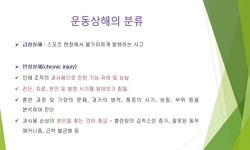
- 1. 운동상해의 개념 7
- 2. 운동상해의 원인 8
- 3. 운동상해 방지 및 안전원리 10
- 4. 운동상해의 유형 11
- 5. 운동상해의 응급처치 13
- 6. 운동상해에 대한 선행연구의 고찰 18
- Ⅲ. 연구방법 20
- 1. 조사도구 20
- 2. 연구대상 21
- 3. 연구기간 22
- 4. 자료처리 23
- Ⅳ. 결과 및 논의 24
- Ⅴ. 결론 및 제언 41
- 참고문헌 44
- ABSTRACT 47
- 부록 50
- 표 목차
- 〈표-1〉운동상해에 영향을 주는 요인 9
- 〈표-2〉설문지의 구성 지표 및 구성내용 20
- 〈표-3〉연구대상 21
- 〈표-4〉연구기간 22
- 〈표-5〉운동경력별 운동상해 계절 25
- 〈표-6〉운동경력별 운동상해 발생시간 25
- 〈표-7〉운동경력별 운동상해 발생부위 26
- 〈표-8〉운동경력별 운동상해 발생시기 27
- 〈표-9〉운동경력별 운동상해 발생원인 28
- 〈표-10〉운동경력별 반복부상 28
- 〈표-11〉운동경력별 부상조치 29
- 〈표-12〉운동경력별 치료기관 30
- 〈표-13〉운동경력별 병원, 의원지시 31
- 〈표-14〉운동경력별 치료효과 방법 32
- 〈표-15〉성별 운동상해 계절 33
- 〈표-16〉성별 운동상해 발생시간 34
- 〈표-17〉성별 운동상해 발생부위 35
- 〈표-18〉성별 운동상해 발생시기 36
- 〈표-19〉성별 운동상해 발생원인 36
- 〈표-20〉성별 반복부상 37
- 〈표-21〉성별 부상조치 38
- 〈표-22〉성별 치료기관 38
- 〈표-23〉성별 병원, 의원지시 39
- 〈표-24〉성별 치료효과 방법 40
분석정보



이 자료와 함께 이용한 RISS 자료
나만을 위한 추천자료


